
This week’s system design refresher:
ByteByteGo Facebook page
What is OSI Model? (Youtube video)
Where do we cache data?
CI/CD Pipeline
What tech stack is commonly used for microservices?
We’ve launched a Facebook page and want our content to be more accessible.
Follow us on FB: https://lnkd.in/eKnvWMx2
Data is cached everywhere, from the front end to the back end!
This diagram illustrates where we cache data in a typical architecture.
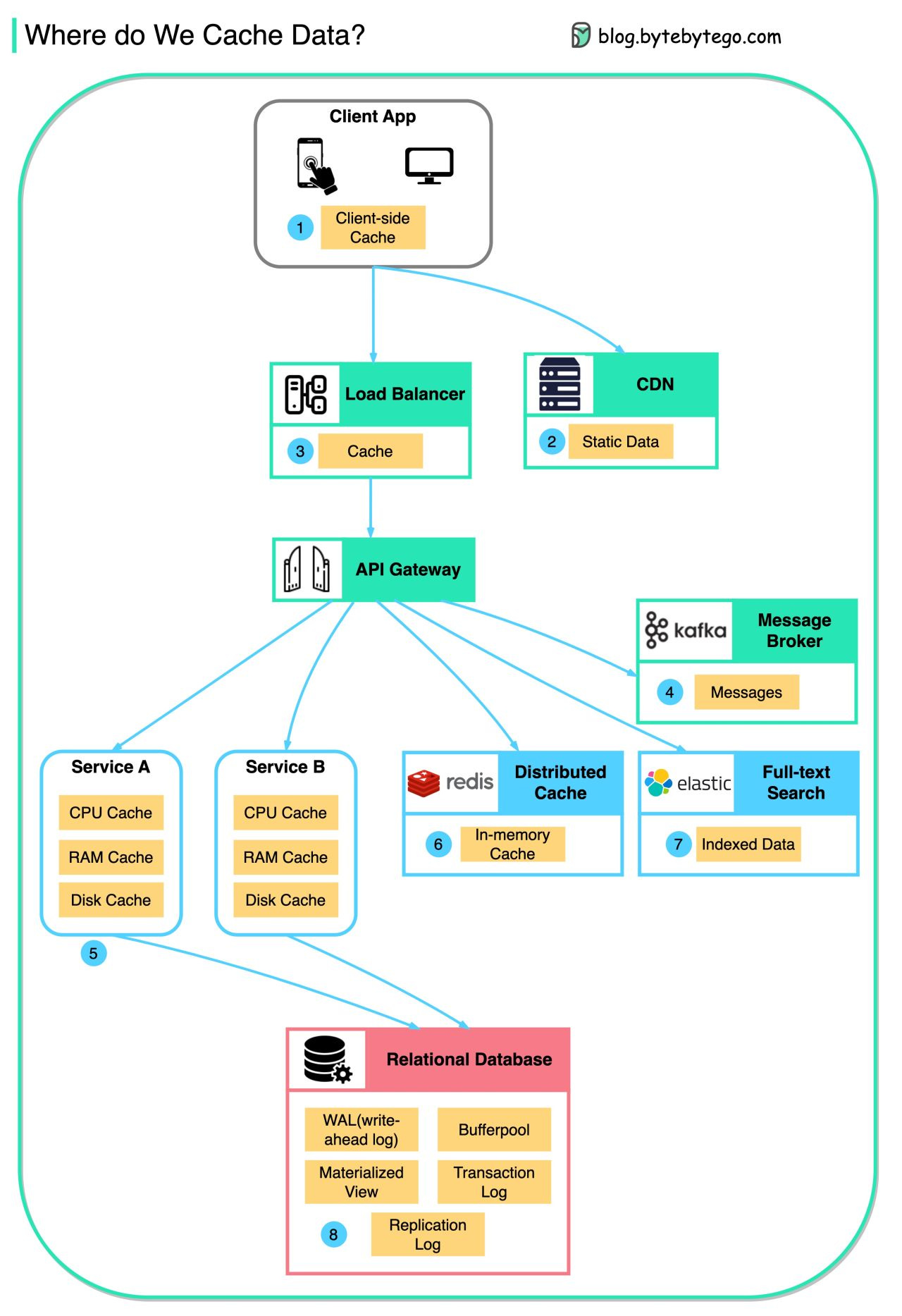
There are multiple layers along the flow.
Client apps: HTTP responses can be cached by the browser. We request data over HTTP for the first time, and it is returned with an expiry policy in the HTTP header; we request data again, and the client app tries to retrieve the data from the browser cache first.
CDN: CDN caches static web resources. The clients can retrieve data from a CDN node nearby.
Load Balancer: The load Balancer can cache resources as well.
Messaging infra: Message brokers store messages on disk first, and then consumers retrieve them at their own pace. Depending on the retention policy, the data is cached in Kafka clusters for a period of time.
Services: There are multiple layers of cache in a service. If the data is not cached in the CPU cache, the service will try to retrieve the data from memory. Sometimes the service has a second-level cache to store data on disk.
Distributed Cache: Distributed cache like Redis hold key-value pairs for multiple services in memory. It provides much better read/write performance than the database.
Full-text Search: we sometimes need to use full-text searches like Elastic Search for document search or log search. A copy of data is indexed in the search engine as well.
Database: Even in the database, we have different levels of caches:
WAL(Write-ahead Log): data is written to WAL first before building the B tree index
Bufferpool: A memory area allocated to cache query results
Materialized View: Pre-compute query results and store them in the database tables for better query performance
Transaction log: record all the transactions and database updates
Replication Log: used to record the replication state in a database cluster
Over to you: With the data cached at so many levels, how can we guarantee the sensitive user data is completely erased from the systems?
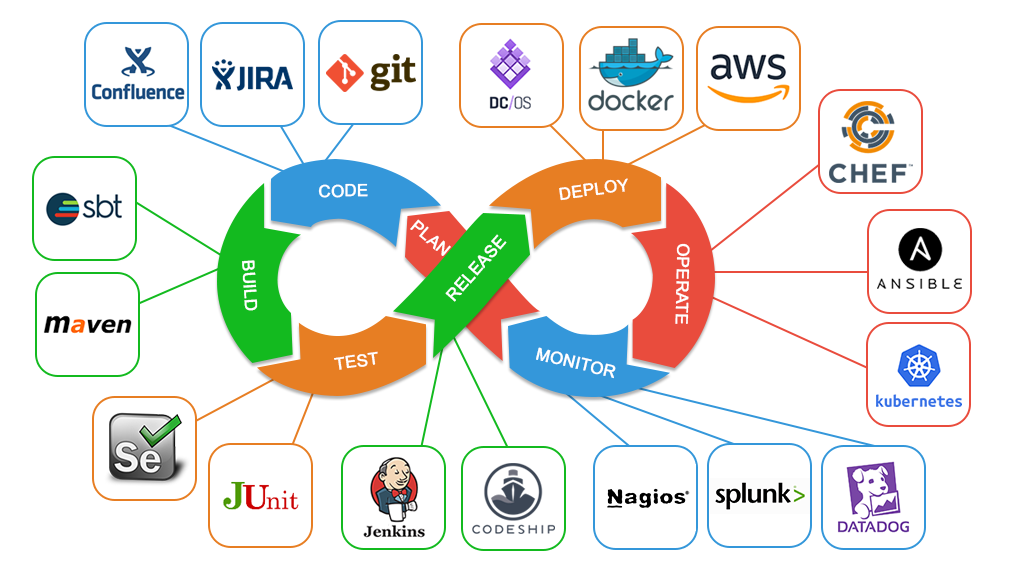
A CI/CD pipeline is a tool that automates the process of building, testing, and deploying software.
It integrates the different stages of the software development lifecycle, including code creation and revision, testing, and deployment, into a single, cohesive workflow.
The diagram below illustrates some of the tools that are commonly used.
Below you will find a diagram showing the microservice tech stack, both for the development phase and for production.
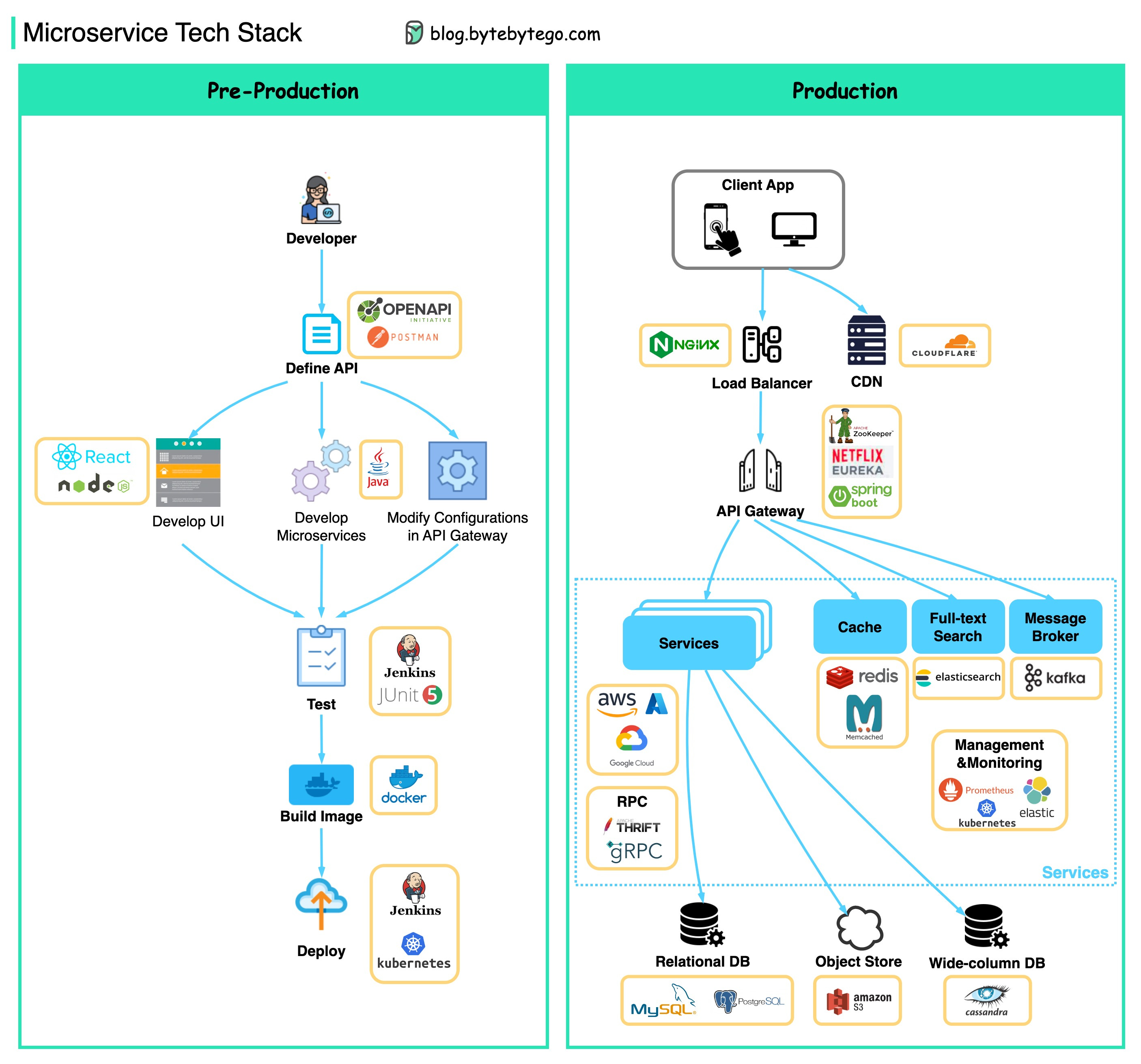
Pre-production
Define API - This establishes a contract between frontend and backend. We can use Postman or OpenAPI for this.
Development - Node.js or react is popular for frontend development, and java/python/go for backend development. Also, we need to change the configurations in the API gateway according to API definitions.
Continuous Integration - JUnit and Jenkins for automated testing. The code is packaged into a Docker image and deployed as microservices.
Production
NGinx is a common choice for load balancers. Cloudflare provides CDN (Content Delivery Network).
API Gateway - We can use spring boot for the gateway, and use Eureka/Zookeeper for service discovery.
The microservices are deployed on clouds. We have options among AWS, Microsoft Azure, and Google GCP.
Cache and Full-text Search - Redis is a common choice for caching key-value pairs. ElasticSearch is used for full-text search.
Communications - For services to talk to each other, we can use messaging infra Kafka or RPC.
Persistence - We can use MySQL or PostgreSQL for a relational database, and Amazon S3 for object store. We can also use Cassandra for the wide-column store if necessary.
Management & Monitoring - To manage so many microservices, the common Ops tools include Prometheus, Elastic Stack, and Kubernetes.
HEIR: Senior Software Engineer, Full Stack (United States)