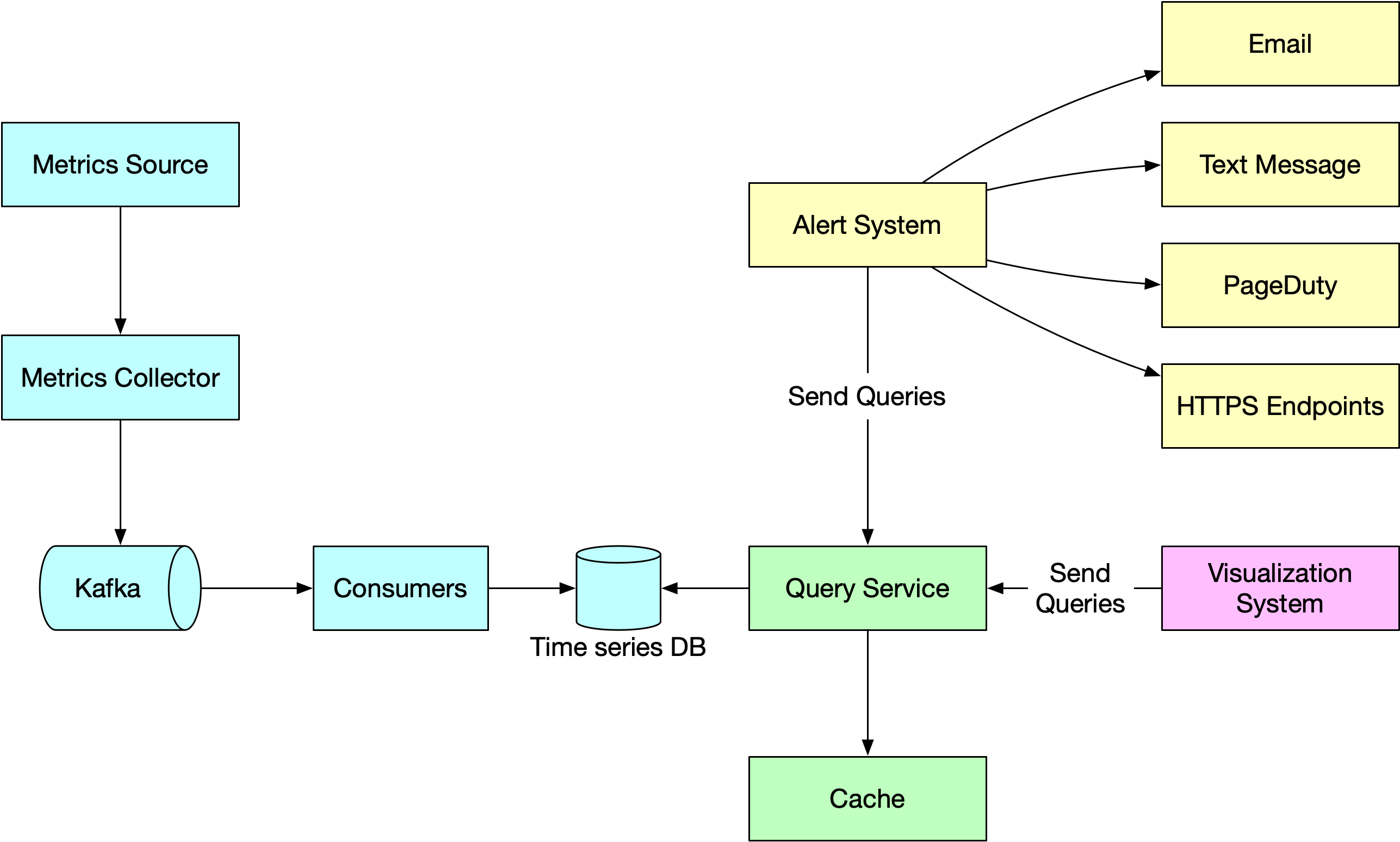
A well-designed metric monitoring and alerting system plays a key role in providing clear visibility into the health of the infrastructure to ensure high availability and reliability. The diagram below explains how it works at a high level.
Metrics source: This can be application servers, SQL databases, message queues, etc.
Metrics collector: It gathers metrics data and writes data into the time-series database.
Time-series database: This stores metrics data as time series. It usually provides a custom query interface for analyzing and summarizing a large amount of time-series data. It maintains indexes on labels to facilitate the fast lookup of time-series data by labels.
Kafka: Kafka is used as a highly reliable and scalable distributed messaging platform. It decouples the data collection and data processing services from each other.
Consumers: Consumers or streaming processing services such as Apache Storm, Flink and Spark, process and push data to the time-series database.
Query service: The query service makes it easy to query and retrieve data from the time-series database. This should be a very thin wrapper if we choose a good time-series database. It could also be entirely replaced by the time-series database’s own query interface.
Alerting system: This sends alert notifications to various alerting destinations.
Visualization system: This shows metrics in the form of various graphs/charts.
If you enjoyed this post, you might like our system design interview books as well.
SDI-vol1: https://amzn.to/3tK0qQn
SDI-vol2: https://amzn.to/37ZisW9